From MCP Tutorials to Conference: My Research Journey

What happens when people use an AI assistant instead of a traditional interface? I share how a question inspired by MCP became my master’s thesis, what I learned from studying users, and why trust matters.
From Curiosity to Conference: Exploring How We Work With AI
What if completing a task online was as simple as telling an AI what you wanted?
As a software engineer, I had been thinking about that question for a while. I was curious about whether conversational AI could help people complete everyday tasks—and how that experience would compare with using the buttons, forms, and menus we already know.
The announcement of the Model Context Protocol (MCP) by Anthropic gave me a way to start exploring the idea. I was also inspired by stories such as Dusk Beyond the End of the World, where characters interact and collaborate with AI companions. Those portrayals made me wonder what working with an AI assistant could feel like beyond a movie or anime.
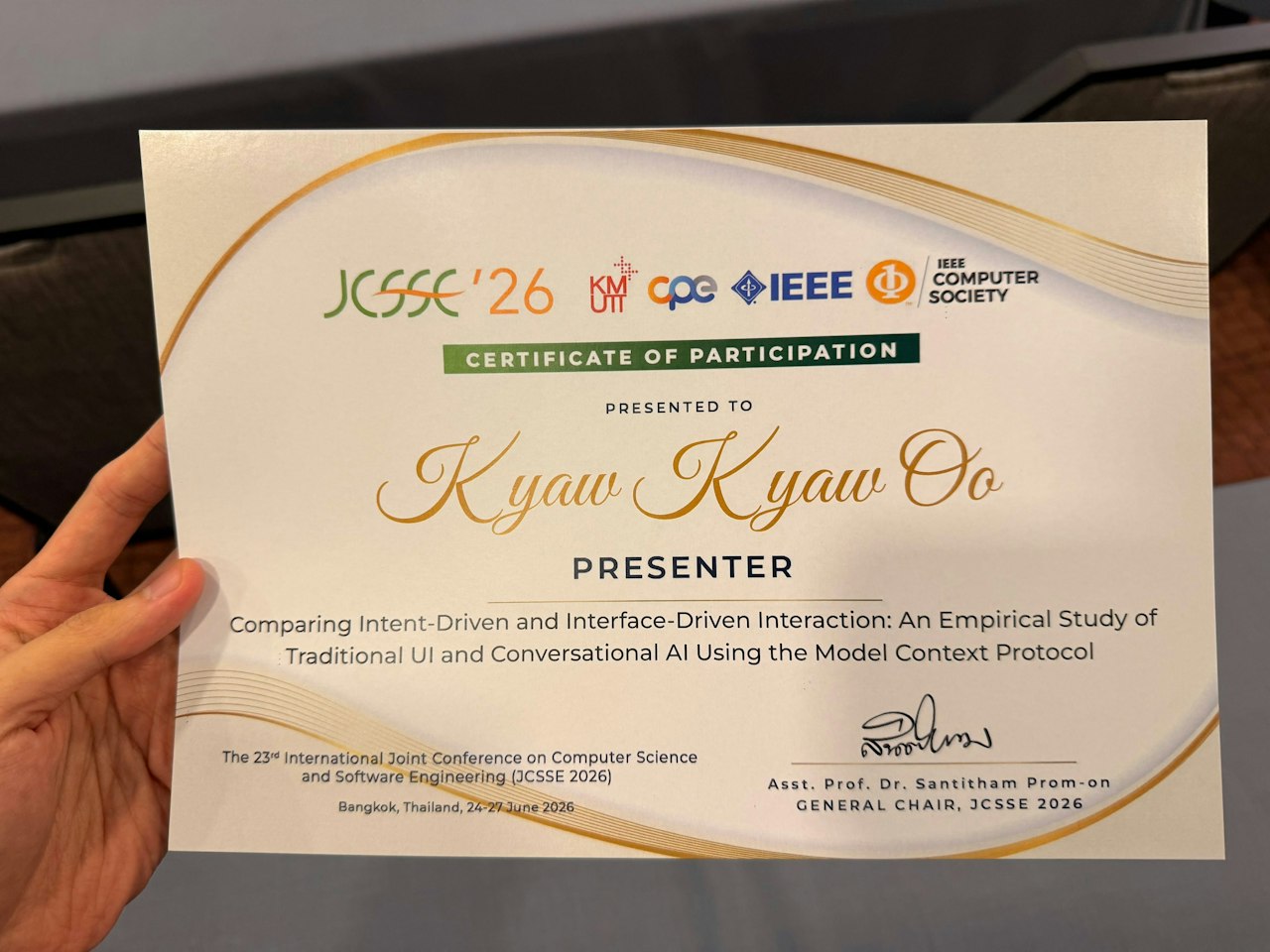
That curiosity eventually became my master’s thesis and a research paper presented at the 23rd International Joint Conference on Computer Science and Software Engineering (JCSSE 2026).
Starting with MCP
My first step was a familiar one for a software engineer: I opened the official documentation.
MCP is a protocol that gives AI applications a standard way to connect with external tools and data sources. Instead of only generating an answer, an AI assistant can use connected tools to help carry out a task.
To understand how it worked, I tried tutorials involving a restaurant ordering system. They showed me how an AI assistant could connect to the system and let someone place an order through conversation.
The idea was exciting, but it also raised a question: Would people actually prefer doing this through a conversation rather than a traditional interface?
I started exploring the question independently, then discussed it with my advisors at Chulalongkorn University. Together, we refined the idea into a study using tasks that participants were likely to recognize: registering for and dropping courses, and booking and canceling room reservations. We hoped that using familiar tasks would give participants a more comparable starting point.
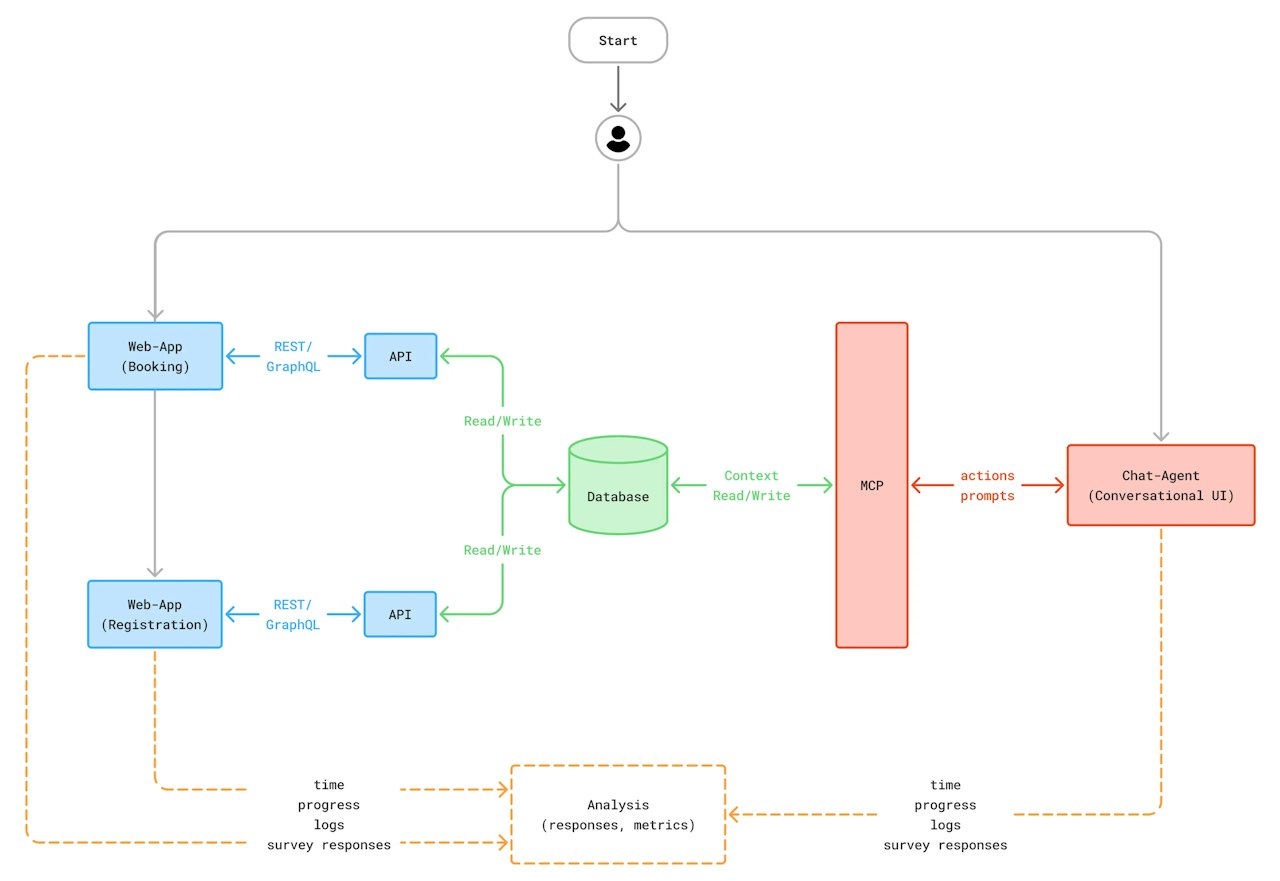
Building two ways to complete the same tasks
For the study, I designed two systems:
- A traditional web interface using menus, forms, and buttons.
- A conversational system where participants could tell an AI assistant what they wanted and use MCP-connected tools to carry out tasks.
Both systems used the same backend database and business logic. That mattered because I wanted participants to compare the interaction experience while working with equivalent functionality.
I used Cursor and Antigravity to help write the code, while I focused on designing the systems and making sure both interfaces could complete the same tasks.
Integrating MCP was one of the most challenging parts. I also had to think about whether the AI was hallucinating or behaving unexpectedly. I spent time checking logs and tracing actions back through the code to understand what the system had done and debug the integration.
Building the prototype taught me that connecting an AI to a system is only part of the work. Understanding its behavior—and making that behavior clear to the person using it—is another challenge.
From building to studying people
With help from my advisors, friends, and relatives, I recruited university students to participate voluntarily. In total, 181 people took part, and 142 completed the full experimental procedure.
Each participant used both systems to complete the same set of tasks. We then compared their responses using measures that looked at usability, workload, and experiences such as autonomy and competence. These included the System Usability Scale (SUS), questions informed by Self-Determination Theory, and the NASA Raw Task Load Index.
I had to learn how to interpret the results along the way. Moving from building software to studying how people experienced it gave me a different perspective: a system can work technically and still feel confusing, demanding, or difficult to trust.
While participants were using the systems, I noticed that some of my more tech-savvy friends were comfortable experimenting with the chat agent. Others preferred the familiar traditional interface.
The result I didn’t expect
Before the study, I expected everyone to prefer the chat agent. Being able to express what you want in natural language seemed like an obvious improvement to me.
The results were more nuanced. In our study, participants with advanced technical experience rated the conversational system more favorably for usability, while the broader group tended to find the traditional interface easier to use and less demanding.
At first, I wondered whether the result meant that my system simply wasn’t strong enough. After looking more closely at the data and discussing it with my advisors, I began to see another lesson: people have different levels of comfort with AI, and a familiar interface can help them feel more in control.
One example was how much detail people gave the assistant. Some participants would ask it to “register any course” without specifying which one. The AI would ask them to choose a specific course instead. From the system’s perspective, it needed more information; from the user’s perspective, the conversation could feel like it had stopped short of completing the request.
The question of trust
The finding that stayed with me most was about trust.
Even among people who preferred the chat agent, there was hesitation about letting it complete tasks without supervision. Some feedback captured that concern clearly: the system was useful, but what would happen if financial information were involved?
That made me think differently about convenience. An interface can save effort and still leave someone uncomfortable if they cannot easily tell what is happening or what action will be taken.
Our findings suggest that conversational AI and traditional interfaces each have strengths. They also point toward a possible hybrid: a user could tell the AI what they want, review the details in a familiar interface, and confirm before the system takes action.
For someone unsure which course to choose, for example, the AI might help narrow down the options while the interface shows the available choices and the final registration details. That design would still need to be tested, but it is a direction I find worth exploring.
Taking the work to JCSSE
After analyzing the results, I worked with my advisors to write and submit the paper. When I learned it had been accepted, I felt happy and excited. It was rewarding to see a question I had started exploring independently become both my master’s thesis and a conference presentation, especially in the human-computer interaction category, which was relatively new territory for me.
At JCSSE, one question was how the system might behave in more complex scenarios—and whether users might prefer a chat agent in those situations.
My intuition is that conversational interaction could become more attractive when a task requires many steps. If ordering an item through a website takes more than ten clicks, asking an assistant might feel simpler. A familiar chat interface could also offer a consistent way to interact across different websites.
That remains a question for future research. Our study focused on specific university tasks and student participants, so its findings should be understood in that context rather than treated as an answer for every user or application.

What I’m taking away
I began this project excited by the possibility of telling AI what to do. I still find that possibility exciting, but the research taught me to pay closer attention to the person on the other side of the interaction.
Different people want different things from a system. Some enjoy experimenting with a conversational assistant. Others value the familiarity and visible control of a traditional interface. And even when people like an AI system, trust cannot be assumed.
I’m most proud that I followed my curiosity, turned it into a research project, and had the opportunity to present it at JCSSE. The experience changed how I think about building AI-powered software: the goal is not only to make an assistant capable, but also to make its actions understandable and useful to the people relying on it.